What is it?
The Wildfire Resilience Scorecard (“the scorecard”) is a free[1] tool for cities and communities to “baseline” their current level of resilience to wildfire risk, so that they can develop well-targeted programs to improve that resilience. If application is repeated (for example, annually), it can also be used to track progress.
Summary: Wildfire Scorecard Summary Version April 2024
How does it work?
The Scorecard is based on the original UN City Disaster Resilience Scorecard, but with expanded coverage to deal with known wildfire-specific issues. Like the City version, the scorecard is structured on the Sendai Framework’s Ten Essentials of Disaster Risk Reduction (see below). These provide the “section headings” for the scorecard.
Figure 1: The Ten Essentials of Disaster Risk Reduction
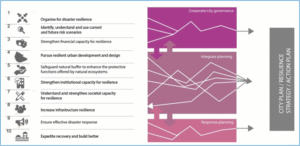
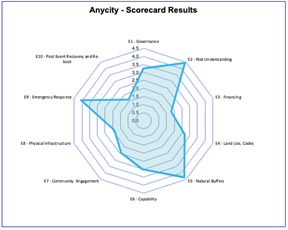
Each section contains a set of questions. Questions are scored by the user, together with notes justifying each score, and a summary spreadsheet tool is available to accumulate scores and present them as a Euler diagram (also known as a radar chart – see figure 2 below).
The Scorecard comes in two versions:
- A preliminary (short form) version, containing about 40 questions.
- A detailed (long form) version, containing some 150 questions.
The short-form version can be used for an “initial look” at the city or community’s wildfire resilience, for consensus building workshops, and as an executive summary of the long-form version. It may require 10 days to complete including set-up and write-up time. The long-form version is used for conducting detailed assessments and may take several weeks depending on the level of detail required.
Figure 2: Format for Showing Scorecard Results
Who should use the scorecard?
The scorecard is intended to be used by any stakeholder in a city or community’s resilience. However, especially in the long form version, some Essentials require specialist expertise such as engineering, landscape management, finance or planning. A typical user group might therefore consist of some combination of representatives from emergency management; mayor’s office; first responders (fire, police); engineering, planning and finance departments; public health; utilities; other city or state governments; business representatives; and community representatives. (It is rare to have all these stakeholders from the start of the exercise). The scorecard itself contains more details on stakeholders, under Essential 1 (Governance).
What if I have already completed another assessment or scorecard?
There are several wildfire resilience assessment tools and your city or community may already have used one. We believe that, with its Ten Essentials structure, the scorecard is more holistic than these other tools, and we encourage you combine it with the data you may already have gathered with the others, to “fill in the gaps” that they may have left.
Who has used the scorecard, and with what benefits?
We do not track users of the wildfire scorecard but we understand that communities in California, Greece and Argentina (at least) have used it. We welcome feedback from users on the benefits they have achieved and on possible improvements.
Obtaining the scorecard
The long-form version of the scorecard, the scoring tool and supporting notes are available from this page: https://www.preventionweb.net/publication/community-wildfire-resilience-scorecard. The short form version is attached below.